
“Blind signing” used to be an accepted risk in DeFi: you click confirm, and hope the smart contract meant what the dApp said it did. That implicit trust has quietly driven a surprising share of on-chain losses. Rabby Wallet’s transaction simulation is designed to reset that dynamic by showing the user precisely how token balances and fees will change before they hit approve. For experienced DeFi users juggling ladders of approvals, cross-chain swaps, and hardware keys, that’s not just a convenience — it alters the decision tree for how and when to interact with smart contracts.
This article compares Rabby’s Chrome extension and related clients with mainstream EVM wallets, explains how pre-transaction simulation works at a mechanism level, covers the trade-offs and limits of that approach, and offers a simple heuristic for when simulation materially reduces risk. If you manage significant positions, work with multi-sig arrangements, or make frequent approvals across chains, you should leave with a clearer model of when Rabby’s features matter and where they don’t.
What Rabby actually does differently: mechanism not marketing
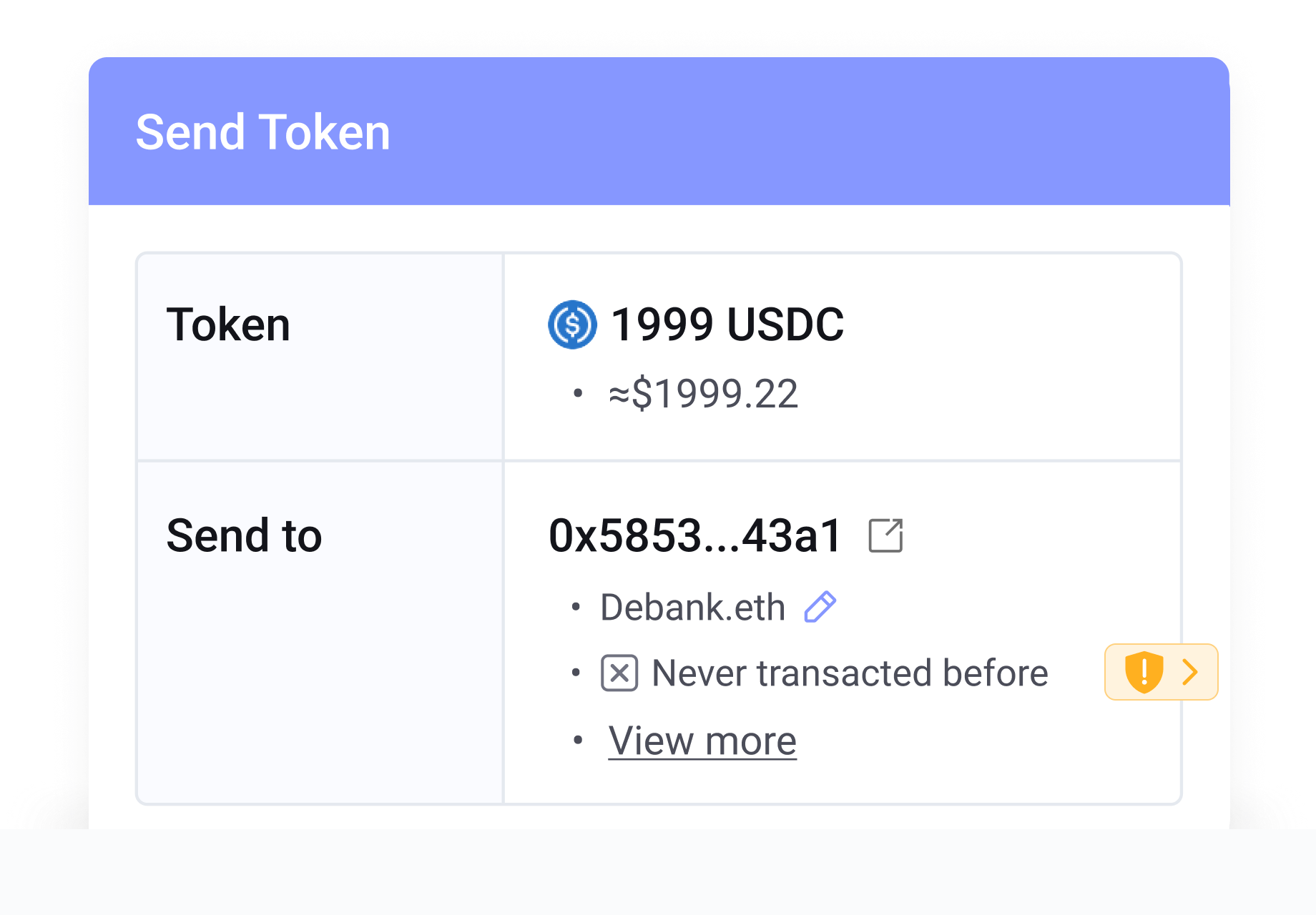
Rabby is a non-custodial, multi-chain wallet built by DeBank that runs in Chromium browsers (and has mobile and desktop clients). The two practical mechanisms that distinguish it are transaction simulation and pre-transaction risk scanning. Transaction simulation executes a dry-run of the exact transaction against a local or remote RPC to compute expected token flows and gas consumption. The wallet then presents a human-readable summary: which tokens move, net balance deltas, and fees in native units and often fiat equivalents. The risk scanner layers heuristics and curated feeds — flagged addresses, historical exploit patterns, suspicious approval sizes — and raises warnings when something smells off.
Mechanistically, simulation is simple in concept but subtle in edge cases. A simulated call uses the same calldata and signed parameters you will send; the difference is it runs under a local node or read-only RPC with state synced to the chain. For deterministic calls, that returns the outcome you should expect. For operations that depend on oracle updates, mempool timing, or ephemeral contract state, the simulation yields a best-effort snapshot, not a guarantee. Rabby makes the interface decision to prioritize exact balance deltas and fee transparency over abstract contract code explanations — a pragmatic design for power users who need rapid, decision-useful signals.
Side-by-side: Rabby vs MetaMask, Trust Wallet, Coinbase Wallet
At the feature level the EVM wallet space overlaps heavily: seed-import, hardware support, network switching, and token tracking are table stakes. Where Rabby diverges is the ordering and integration of security-first features: automatic network switching, approval revocation in-wallet, multi-sig and institutional integrations (Gnosis Safe, Fireblocks, Amber, Cobo), and—critically—pre-sign simulation. MetaMask remains the dominant interface with enormous dApp compatibility and an ecosystem effect, while Trust Wallet and Coinbase Wallet focus on broad consumer access, fiat on-ramps, and simple UX. Rabby sits between those poles: more security tooling than a consumer wallet, less organizationally entrenched than MetaMask but more explicitly designed for DeFi safety than most peers.
Concrete trade-offs to weigh:
- Safety vs. Convenience: Simulation reduces “what happened?” ambiguity, but adds another step and potential cognitive load. Power users value the extra confirmation; casual users may perceive it as friction.
- Determinism vs. Edge Cases: Simulations are accurate for deterministic contract logic but can be misleading where off-chain oracles, pending mempool state, or time-sensitive contracts matter. Rabby’s UI and warnings try to communicate that, but the limitation remains.
- Auditability vs. Centralization: Rabby’s open-source MIT codebase enables audits and community review. Yet some security features rely on curated threat feeds and heuristics that are maintained centrally — a pragmatic trade-off between live protection and pure decentralization.
How simulation prevents common attack vectors — and where it doesn’t
Transaction simulation directly addresses two common classes of user error and attacker technique. First, it prevents blind approvals: users frequently sign token approvals that permit unlimited spend. Seeing net balance deltas and the exact recipient contract makes it far harder to approve a permission that will immediately drain a token. Second, simulation exposes unexpected fee costs and multi-step behavior in complex swaps, so users stop blaming “gas spikes” when a contract calls other protocols. Rabby also offers in-wallet approval revocation, which closes the window of exposure after a mistaken approval.
But simulation does not eliminate risk. If a dApp requires you to sign a meta-transaction or relies on off-chain relayers with front-running or reordering risk, a simulation run now does not protect you from later chain-state changes. Similarly, if a private key is already compromised, showing a preview of the transaction doesn’t prevent an attacker from submitting competing transactions. In short: simulation is a powerful risk-reduction tool for correct-by-design contracts and user errors; it is not a panacea for every attack vector.
Institutional and hardware workflows: where Rabby can be decisive
For teams and heavy traders, two practical features matter: multi-sig/enterprise integration and hardware wallet compatibility. Rabby integrates with Gnosis Safe and custody solutions like Fireblocks and Cobo, meaning it can slot into institutional signing flows rather than competing with them. Its hardware wallet support (Ledger, Trezor, Keystone, and others) is comprehensive, allowing users to keep private keys offline while still getting the simulation and risk scanning benefits in the interface.
Operationally, the most useful effect is behavioral: teams typically set policies around approvals and confirmations. When every approval is accompanied by a simulation showing net token movement, the human verifier is less likely to rubber-stamp an approval request buried in a busy UI. For institutional treasury operations, that can translate directly into fewer costly mistakes.
Practical heuristics: when to prefer Rabby and when to accept alternatives
Three simple heuristics will help you choose:
- If you routinely grant large or unlimited approvals, favor a wallet that simulates and exposes balance deltas. The behavioral friction reduces accidental allowances.
- If you prioritize the broadest dApp compatibility and network-effect liquidity, MetaMask’s ubiquity still matters; pair it with a security-focused wallet in your workflow rather than using a single tool for everything.
- If your use case is consumer-style (fiat on-ramps, buy-and-hold, occasional swaps), a wallet with integrated fiat rails and simple UX may be better — Rabby lacks a native fiat on-ramp and in-wallet staking, which matters for the buy-and-hold customer segment.
Operational takeaway: DeFi power users should treat transaction simulation as part of a defense-in-depth strategy, not the only defense. Combine it with hardware keys, approval revocation routines, and conservative approval policies.
Limitations, uncertainty, and realistic expectations
Be explicit about limits. Rabby’s simulation is only as good as the RPC and state it uses; it cannot predict future oracle swings or mempool frontrunning that depends on latency. Its pre-transaction risk scanning is heuristic-driven; false positives and false negatives will occur. The wallet’s past incident in 2022 (a Rabby Swap contract exploit that cost about $190,000) shows two useful points: (1) tooling matters, but smart-contract bugs in associated infrastructure still create real risk; (2) the team’s response — freezing the contract and compensating users — is evidence of active operational risk management, not proof of invulnerability.
Finally, Rabby lacks a built-in fiat on-ramp and native staking UI today, which may be limiting for US users who prefer a single app experience to buy, stake, and manage taxes. Those are conscious product trade-offs: the team focused on multi-chain DeFi workflows and security tooling rather than becoming a full-scope consumer app.
What to watch next: signals that would change the calculus
Several developments would be decision-relevant in the near term. Wider integration of simulation and risk-scanning standards across other wallet UIs would reduce lock-in and change the competitive dynamic. Similarly, improvements in decentralized, verifiable state oracles that can be queried for pre-sign guarantees would narrow the gap between simulation and guaranteed execution. Adoption signals to watch: updates adding native fiat rails, expanded staking features, changes to how threat feeds are curated, and any security audit results that materially change the wallet’s risk profile.
Meanwhile, for US users, regulatory clarity about custody and on-ramp integrations could push wallets toward more hybrid custodial models; that would reshape how non-custodial wallets position security versus convenience.
Where to start if you want to try Rabby safely
If you’re a power user and want to evaluate Rabby in a low-risk way, import a read-only or limited wallet first, enable hardware signing, and practice on small-value transactions to see how simulation captures common DeFi patterns. Make use of the approval revocation tool to inspect existing allowances and revoke anything you no longer need. If you use both MetaMask and Rabby, the browser extension flip feature makes it easy to switch default behaviors and test workflows without sacrificing convenience.
For readers who want a practical first step, try installing the Rabby extension in a separate browser profile and run through a swap simulation to compare the predicted balance deltas against the executed result on a small trade. That exercise reveals both the power and the boundary conditions of the simulation feature faster than theory does. You can find the extension here: rabby wallet extension.
FAQ
Does transaction simulation guarantee I won’t lose funds?
No. Simulation materially reduces the chance of mistakes caused by blind signing and unexpected token flows, but it cannot guarantee outcomes that depend on future on-chain state (oracle updates, mempool reordering) or protect against a compromised private key. Treat simulation as a complementary tool in a defense-in-depth strategy: combine it with hardware wallets, careful approval policies, and periodic allowance revocation.
How reliable are Rabby’s risk warnings?
Rabby’s risk engine uses curated threat feeds and heuristics to flag suspicious contracts and behaviors. That makes it effective at catching known malicious addresses and common exploit patterns, but it also means false positives and negatives are possible. The engine is useful for prioritizing human review, not for automated trust decisions that assume perfect detection.
Can I use Rabby with hardware wallets and multi-sig setups?
Yes. Rabby supports many hardware devices (Ledger, Trezor, Keystone, and more) and integrates with institutional/multi-sig solutions like Gnosis Safe, Fireblocks, Amber, and Cobo. This makes it practical for team treasuries and enterprise workflows where offline signing and policy controls matter.
Is Rabby a replacement for MetaMask?
Not necessarily. MetaMask still benefits from ecosystem ubiquity and dApp compatibility. Rabby offers a different set of trade-offs—stronger built-in security tooling and simulation—so power users often run both and choose the right tool per task. For users prioritizing integrated fiat on-ramps, Rabby currently lags consumer-focused wallets.